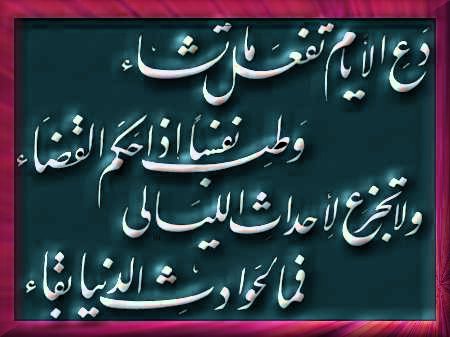
Islamic Arabic Calligraphy - Let life happen and be thankful to Allah
Do not dwell on the negative as it will soon come to pass
"O moon-faced Beloved,
the month of Ramadan has arrived.
Cover the table
and open the path of praise."
The great Muslim poet Jalal al-Din Rumi sang about Ramadan in the 13th century AD (translation by A.J. Arberry):
"The month of fasting has come, the emperor's banner has arrived; withhold your hand from food, the spirit's table has arrived.
The soul has escaped from separation and bound nature's hands; the heart of error is defeated, the army of faith has arrived.
Fasting is our sacrifice, it is the life of our soul; let us sacrifice all our body, since the soul has arrived as guest.
Fortitude is as a sweet cloud, wisdom rains from it, because it was in such a month of fortitude that the Koran arrived.
...Wash your hands and your mouth, neither eat nor speak; seek that speech and that morsel which has come to the silent ones."
Rumi on Fasting:
There’s hidden sweetness in the stomach’s emptiness.
We are lutes, no more, no less.
If the soundboxes stuffed full of anything, no music.
If the brain and belly are burning clean with fasting,
every moment a new song comes out of the fire.
The fog clears, and new energy makes you run
up the steps in front of you.
Be emptier and cry like reed instruments cry.
Emptier, write secrets with the reed pen.
When you’re full of food and drink,
Satan sits where your spirit should,
an ugly metal statue in place of the Kaaba.
When you fast, good habits gather
like friends who want to help.
Fasting is Solomon’s ring.
Don’t give into some illusion and lose your power,
but even if you have, if you’ve lost all will and control,
they come back when you fast,
like soldiers appearing out of the ground,
pennants flying above them.
A table descends to your tents, Jesus’ table.
Expect to see it, when you fast,
this tablespread with other food,
better than the broth of cabbages.
Ramadan is the ninth month of the Muslim lunar year. It has double significance as this is the month that the Holy Quran was revealed to Prophet Muhammad and that night has been called the Night of Power - Layla-tul Qadr, the night where a single moment of enlightenment of the Noor of Allah converts the night into a period of Spiritual glory and majesty that touches eternity. Pious Muslims strive to make themselves pure, especially during this month, by ritual and spiritual observances to make ready for Companionship on High. This month has been declared sacred in the Holy Quran wherein God says:
2:183 - O you who believe, fasting is prescribed on you as it was prescribed
to those before you so that you may become self-restrained.
2:185 - The prescribed fasting is for a fixed number of days, but whoso
among you is sick or on a journey, shall fast the same number of other
days; and for those who are able to fast only with great difficulty, is
an expiation - the feeding of a poor man. And whoso does good of his own
accord it is better for him. And fasting is good for you, if you only knew.
For the last 1400 years, over one billion Muslims throughout the world, believers pay special
attention to the esoteric (batin) matters by practicing the exoteric (zaher)
fasting by refraining from dishonesty, stealing, unethical actions, and
other activities that would lead one astray. A Momin's (believer's)
life is a journey to become one with the Essence and her daily life is
a mirror of her spiritual beauty. A Muslim lives a daily life of piety which includes practice of faith and taking care of life, that means, working for the family, earning and taking part in society whilst also maintaining a relationship with the Creator-on-high. So the tasbi (rosary) will be in contstant use to remember God and recall this link with the Spirit and Soul.
During Ramadan, Muslims fast from sun-up to sun-down daily, not having anything to eat, drink, smoke and keep away from sexual relations during that period. A special feast is prepared for the breaking of the fast each evening, where everyone present is invited to partake of the dinner after the all-day fast where prayers of thanks are offered and family and friends reconnect and rejoice for remembering their duty to God and for striving to be pious.
The month ends with special festivities on the Eid al-Fitr
(Day of Feasting) celebration when families and friends truly rejoice for
having completed the commandment of Allah by successful abstinence and
by zikr (remembrance of Allah) at all times.
"The healthy human body is the temple in which the flame of the Holy
Spirit burns, and thus it deserves the respect of scrupulous cleanliness and
personal hygiene. Prayer is a daily necessity, a direct communication
of
the spark with the Universal flame. Reasonable fasting for a month
in every
year, provided a man's health is not impaired thereby, is an essential
part
of the body's discipline -through which the body learns to renounce
all
impure desires. Adultery, alcoholism, slander and thinking evil of
one's
neighbour are specifically and severely condemned. All men, rich and
poor,
must aid one another materially and personally. The rules vary in detail,
but they all maintain the principle of universal mutual aid in the
Muslim
fraternity. This fraternity is absolute, and it comprises men of all
colours and all races: black, white, yellow, tawny; all are the sons
of
Adam in the flesh and all carry in them spark of the Divine Light.
Everyone
should strive his best to see that this spark be not extinguished but
rather developed to that full "Companionship-on-High"
which was the
vision expressed in the last words of the Prophet on his deathbed,
the
vision of that blessed state which he saw clearly awaiting him. In
Islam
the Faithful believe in Divine justice and are convinced that the solution
of the great problem of predestination and free will is to be found
in the
compromise that God knows what man is going to do, but that man is
free to
do it or not."
Full text at:
Memoirs - Religion of my AncestorsPresident Barack Obama's message from the White House to the Muslim World - see video message and press release below
The White House
Office of the Press Secretary
For Immediate Release
August 11, 2010
Statement by the President Barack Obama on the Occasion of Ramadan August 11, 2010
On behalf of the American people, Michelle and I want to extend our best wishes to Muslims in America and around the world. Ramadan Kareem.
Ramadan is a time when Muslims around the world reflect upon the wisdom and guidance that comes with faith, and the responsibility that human beings have to one another, and to God. This is a time when families gather, friends host iftars, and meals are shared. But Ramadan is also a time of intense devotion and reflection – a time when Muslims fast during the day and pray during the night; when Muslims provide support to others to advance opportunity and prosperity for people everywhere. For all of us must remember that the world we want to build – and the changes that we want to make – must begin in our own hearts, and our own communities.
These rituals remind us of the principles that we hold in common, and Islam’s role in advancing justice, progress, tolerance, and the dignity of all human beings. Ramadan is a celebration of a faith known for great diversity and racial equality. And here in the United States, Ramadan is a reminder that Islam has always been part of America and that American Muslims have made extraordinary contributions to our country. And today, I want to extend my best wishes to the 1.5 billion Muslims around the world – and your families and friends – as you welcome the beginning of Ramadan.
I look forward to hosting an Iftar dinner celebrating Ramadan here at the White House later this week, and wish you a blessed month.
May God’s peace be upon you.
Statement by the President on the Occasion of Eid-ul-Fitr September 09, 2010
As Ramadan comes to an end, Michelle and I extend our best wishes to Muslims in the United States and around the world on the occasion of Eid-ul-Fitr. For Muslims all over the world, Eid ul-Fitr marks the end of a holy month of fasting and prayer. It is a time of self-reflection focusing on the values that Muslims and people of all faiths share - charity, community, cooperation and compassion. This year’s Eid is also an occasion to reflect on the importance of religious tolerance and to recognize the positive role that religious communities of all faiths, including Muslims, have played in American life.
On this Eid, those devastated by the recent floods in Pakistan will be on the minds of many around the world. To help in the tremendous relief, recovery, and reconstruction effort for the floods, all Americans can participate by donating to the Pakistan Relief Fund at www.state.gov.
On behalf of the American people, we congratulate Muslims in the United States and around the world on this blessed day. Eid Mubarak.
Remarks of President Barack Obama
Ramadan Message
Washington, DC
On behalf of the American people – including Muslim communities in all fifty states – I want to extend best wishes to Muslims in America and around the world. Ramadan Kareem.
Ramadan is the month in which Muslims believe the Koran was revealed to the Prophet Muhammad, beginning with a simple word – iqra. It is therefore a time when Muslims reflect upon the wisdom and guidance that comes with faith, and the responsibility that human beings have to one another, and to God.
Like many people of different faiths who have known Ramadan through our communities and families, I know this to be a festive time – a time when families gather, friends host iftars, and meals are shared. But I also know that Ramadan is a time of intense devotion and reflection – a time when Muslims fast during the day and perform tarawih prayers at night, reciting and listening to the entire Koran over the course of the month.
These rituals remind us of the principles that we hold in common, and Islam’s role in advancing justice, progress, tolerance, and the dignity of all human beings.
For instance, fasting is a concept shared by many faiths – including my own Christian faith – as a way to bring people closer to God, and to those among us who cannot take their next meal for granted. And the support that Muslims provide to others recalls our responsibility to advance opportunity and prosperity for people everywhere. For all of us must remember that the world we want to build – and the changes that we want to make – must begin in our own hearts, and our own communities.
This summer, people across America have served in their communities – educating children, caring for the sick, and extending a hand to those who have fallen on hard times. Faith-based organizations, including many Islamic organizations, have been at the forefront in participating in this summer of service. And in these challenging times, this is a spirit of responsibility that we must sustain in the months and years to come.
Beyond America’s borders, we are also committed to keeping our responsibility to build a world that is more peaceful and secure. That is why we are responsibly ending the war in Iraq. That is why we are isolating violent extremists while empowering the people in places like Afghanistan and Pakistan. That is why we are unyielding in our support for a two-state solution that recognizes the rights of Israelis and Palestinians to live in peace and security. And that is why America will always stand for the universal rights of all people to speak their mind, practice their religion, contribute fully to society and have confidence in the rule of law.
All of these efforts are a part of America’s commitment to engage Muslims and Muslim-majority nations on the basis of mutual interest and mutual respect. And at this time of renewal, I want to reiterate my commitment to a new beginning between America and Muslims around the world.
As I said in Cairo, this new beginning must be borne out in a sustained effort to listen to each other, to learn from each other, to respect one another, and to seek common ground. I believe an important part of this is listening, and in the last two months, American embassies around the world have reached out not just to governments, but directly to people in Muslim-majority countries. From around the world, we have received an outpouring of feedback about how America can be a partner on behalf of peoples’ aspirations.
We have listened. We have heard you. And like you, we are focused on pursuing concrete actions that will make a difference over time – both in terms of the political and security issues that I have discussed, and in the areas that you have told us will make the most difference in peoples’ lives.
These consultations are helping us implement the partnerships that I called for in Cairo – to expand education exchange programs; to foster entrepreneurship and create jobs; and to increase collaboration on science and technology, while supporting literacy and vocational learning. We are also moving forward in partnering with the OIC and OIC member states to eradicate polio, while working closely with the international community to confront common health challenges like H1N1 – which I know is of particular to concern to many Muslims preparing for the upcoming hajj.
All of these efforts are aimed at advancing our common aspirations – to live in peace and security; to get an education and to work with dignity; to love our families, our communities, and our God. It will take time and patient effort. We cannot change things over night, but we can honestly resolve to do what must be done, while setting off in a new direction – toward the destination that we seek for ourselves, and for our children. That is the journey that we must travel together.
I look forward to continuing this critically important dialogue and turning it into action. And today, I want to join with the 1.5 billion Muslims around the world – and your families and friends – in welcoming the beginning of Ramadan, and wishing you a blessed month. May God’s peace be upon you.
__________________________________________________________________________
For Immediate Release September 1, 2009
REMARKS BY THE PRESIDENT
AT IFTAR DINNER
State Dining Room
8:08 P.M. EDT
THE PRESIDENT: Please, everybody have a seat. Thank you. Well, it is my great pleasure to host all of you here at the White House to mark this special occasion -- Ramadan Kareem.
I want to say that I'm deeply honored to welcome so many members of the diplomatic corps, as well as several members of my administration and distinguished members of Congress, including the first two Muslims to serve in Congress -- Keith Ellison and Andre Carson. Where are they? (Applause.)
Just a few other acknowledgements I want to make. We have Senator Richard Lugar here, who's our Ranking Member of the Foreign Affairs Committee. Where is Dick Lugar? There he is. (Applause.) Representative John Conyers, Chairman of the Judiciary Committee. (Applause.) Representative Rush Holt is here. Thank you, Rush. (Applause.) Have we found you a seat, Rush? (Laughter.)
REPRESENTATIVE HOLT: I’m on my way to the train. (Laughter.)
THE PRESIDENT: I got you.
We also have here -- Secretary of Defense Gates is here. Secretary Gates. (Applause.) Our Attorney General, Eric Holder. (Applause.) And Secretary of Health and Human Services, Kathleen Sebelius is here. (Applause.)
And most of all, I want to welcome all the American Muslims from many walks of life who are here. This is just one part of our effort to celebrate Ramadan, and continues a long tradition of hosting iftars here at the White House.
For well over a billion Muslims, Ramadan is a time of intense devotion and reflection. It's a time of service and support for those in need. And it is also a time for family and friends to come together in a celebration of their faith, their communities, and the common humanity that all of us share. It is in that spirit that I welcome each and every one of you to the White House.
Tonight's iftar is a ritual that is also being carried out this Ramadan at kitchen tables and mosques in all 50 states. Islam, as we know, is part of America. And like the broader American citizenry, the American Muslim community is one of extraordinary dynamism and diversity -- with families that stretch back generations and more recent immigrants; with Muslims of countless races and ethnicities, and with roots in every corner of the world.
Indeed, the contribution of Muslims to the United States are too long to catalog because Muslims are so interwoven into the fabric of our communities and our country. American Muslims are successful in business and entertainment; in the arts and athletics; in science and in medicine. Above all, they are successful parents, good neighbors, and active citizens.
So on this occasion, we celebrate the Holy Month of Ramadan, and we also celebrate how much Muslims have enriched America and its culture -- in ways both large and small. And with us here tonight, we see just a small sample of those contributions. Let me share a few stories with you briefly.
Elsheba Khan's son, Kareem, made the ultimate sacrifice for his country when he lost his life in Iraq. Kareem joined the military as soon as he finished high school. He would go on to win the Purple Heart and Bronze Star, along with the admiration of his fellow soldiers. In describing her son, Elsheba said, "He always wanted to help any way that he could." Tonight, he's buried alongside thousands of heroes in Arlington National Cemetery. A crescent is carved into his grave, just as others bear the Christian cross or the Jewish star. These brave Americans are joined in death as they were in life -- by a common commitment to their country, and the values that we hold dear.
One of those values is the freedom to practice your religion -- a right that is enshrined in the First Amendment of the Constitution. Nashala Hearn, who joins us from Muskogee, Oklahoma, took a stand for that right at an early age. When her school district told her that she couldn't wear the hijab, she protested that it was a part of her religion. The Department of Justice stood behind her, and she won her right to practice her faith. She even traveled to Washington to testify before Congress. Her words spoke to a tolerance that is far greater than mistrust -- when she first wore her headscarf to school, she said, "I received compliments from the other kids."
Another young woman who has thrived in her school is Bilqis Abdul-Qaadir. She's not even 5'5 -- where's Bilqis? Right here. Stand up, Bilqis, just so that we -- (laughter) -- I want everybody to know -- she's got heels on. She's 5'5 -- Bilqis broke Rebecca Lobo's record for the most points scored by any high school basketball player in Massachusetts history. (Applause.) She recently told a reporter, "I'd like to really inspire a lot of young Muslim girls if they want to play basketball. Anything is possible. They can do it, too." As an honor student, as an athlete on her way to Memphis, Bilqis is an inspiration not simply to Muslim girls -- she's an inspiration to all of us.
Of course, we know that when it comes to athletes who have inspired America, any list would include the man known simply as The Greatest. And while Muhammad Ali could not join us tonight, it is worth reflecting upon his remarkable contributions, as he's grown from an unmatched fighter in the ring to a man of quiet dignity and grace who continues to fight for what he believes -- and that includes the notion that people of all faiths holds things in common. I love this quote. A few years ago, he explained this view -- and this is part of why he's The Greatest -- saying, "Rivers, ponds, lakes and streams -- they all have different names, but they all contain water. Just as religions do -- they all contain truths."
They all contain truths. Among those truths are the pursuit of peace and the dignity of all human beings. That must always form the basis upon which we find common ground. And that is why I am so pleased that we are joined tonight not only by so many outstanding Muslim Americans and representatives of the diplomatic corps, but people of many faiths -- Christians, Jews, and Hindus -- along with so many prominent Muslims.
Together, we have a responsibility to foster engagement grounded in mutual interest and mutual respect. And that's one of my fundamental commitments as President, both at home and abroad. That is central to the new beginning that I've sought between the United States and Muslims around the world. And that is a commitment that we can renew once again during this holy season.
So tonight, we celebrate a great religion, and its commitment to justice and progress. We honor the contributions of America's Muslims, and the positive example that so many of them set through their own lives. And we rededicate ourselves to the work of building a better and more hopeful world.
So thanks to all of you for taking the time to be here this evening. I wish you all a very blessed Ramadan. And with that, I think we can start a feast. I don't know what's on the menu, but I'm sure it will be good. (Laughter.) Thank you very much, everybody. (Applause.)
Remarks by the President Bush At Iftaar Dinner
The State Dining Room
5:50 P.M. EST - November 19, 2001
THE PRESIDENT: Good evening, and welcome to the White
House. I'm so honored to welcome such distinguished guests
and ambassadors during the holy month of Ramadan.
America is made better by millions of Muslim
citizens. America has close and important relations with
many Islamic nations. So it is fitting for America to honor
your friendship and the traditions of a great faith by hosting this
Iftaar at the White House.
I want to thank our Secretary of State for being here, as well as
members of my administration. I want to thank the
ambassadors for taking time in this holy month to come to join us in
this feast.
Ramadan is a time of fasting and prayer for the Muslim
faithful. So tonight we are reminded of God's greatness and
His commandments to live in peace and to help neighbors in
need. According to Muslim teachings, God first revealed His
word in the holy Qur'an to the prophet, Muhammad, during the month of
Ramadan. That word has guided billions of believers across
the centuries, and those believers built a culture of learning and
literature and science.
All the world continues to benefit from this faith and its
achievements. Ramadan and the upcoming holiday season are a
good time for people of different faiths to learn more about each
other. And the more we learn, the more we find that many
commitments are broadly shared. We share a commitment to
family, to protect and love our children. We share a belief
in God's justice, and man's moral responsibility. And we
share the same hope for a future of peace. We have much in
common and much to learn from one another.
This evening, we gather in a spirit of peace and
cooperation. I appreciate your support of our objectives in
the campaign against terrorism. Tonight that campaign
continues in Afghanistan, so that the people of Afghanistan will soon
know peace. The terrorists have no home in any
faith. Evil has no holy days.
This evening we also gather in the spirit of generosity and
charity. As this feast breaks the Ramadan fast, America is also
sharing our table with the people of Afghanistan. We are
proud to play a leading role in humanitarian relief efforts, with air
drops and truck convoys of food and medicine. America's
children are donating their dollars to the Afghan
children. And my administration is committed to help
reconstruct that country, and to support a stable government that
represents all of the people of Afghanistan.
We are working for more opportunity and a better life for the
people of Afghanistan, and all the people of the Islamic
world. America respects people of all faiths, and America
seeks peace with people of all faiths.
I thank you for your friendship, and I wish you a blessed Ramadan.
Remarks by President William Clinton at event commemorating end of Ramadan
11:30 A.M. EST January 10, 2000 Presidential Hall - The Whitehouse
THE PRESIDENT: Thank you. Thank you very much, Eid
Mubarak, and welcome to the White House. N'Imah
Saleem, you did a fine job for a 14-year-old, or a
24-year-old, or a 44-year-old. I thought she was terrific.
Thank you very much, thank you. (Applause.)
And, Imam Hendi, thank you so much for your words,
your prayer, and for serving as the first Muslim chaplain of
my alma mater, Georgetown University. Congratulations.
We're glad to have you here. Thank you, sir. (Applause.)
I'd like to welcome others from the administration who
very joined us -- our National Security Advisor, Sandy
Berger; Assistant Secretary of State Harold Koh. We also
have a White House fellow here, Khalid Azim; and Dr.
Islam Siddiqui, the senior advisor to the Secretary of
Agriculture and the highest ranking Muslim in the Clinton
administration. We thank him for being here. We have a
Muslim Army chaplain, Captain Muhammad. We thank
him for being here, and the other Muslims who work here
in the White House -- they are all particularly welcome --
and all the rest of you who have come here. Let me say
welcome to you. (Applause.)
My friend, Rasheed, thank you for leading the applause
there. I always try to have someone in the audience there
who is pumping the crowd at the right time. (Laughter.)
Let me also say a special word of welcome to you from
the First Lady. Hillary has done this celebration for the
past several years; many of you have been here with her.
And she had to be out of the city today, and that's the only
reason she's not here, because this means so very much to
her. And I want to welcome you here on her behalf, as
well.
Over the weekend, along with Muslims all over the world,
you celebrated the end of the holy month of Ramadan. The
month of daily fasting is not only a sacred duty, it is also a
powerful teaching, and in many ways a gift of Islam to the
entire rest of the world -- reminding not simply Muslims,
but all people, of our shared obligation to aid those who
live with poverty and suffering. It reminds us that we must
work together to build a more humane world.
I must say, it was, I thought, especially fitting that we
celebrated the Eid at the end of the first round of the talks
between the Syrians and the Israelis. And I thought it was
particularly moving that Imam read the passage from the
Koran that said that Allah created nations and tribes that
we might know one another, not that we might despise one
another.
There's a wonderful passage in the Hebrew Torah, which
warns people never to turn aside the stranger, for it is like
turning aside the most high God. And the Christian Bible
says that people should love their neighbor as themselves.
But it's quite wonderful to say that Allah created the
nations and tribes that they might know one another better,
recognizing people have to organize their thoughts and
categorize their ideas, but that does not mean we should
be divided one from another.
It has been a great blessing for me, being involved in these
talks these last few days, to see the impact of the month of
Ramadan and the Eid on the believers in the Syrian
delegation who are here. It was quite a moving thing. And
I hope that your prayers will stay with them.
Let me say, also, that there is much that the world can
learn from Islam. It is now practiced by one of every four
people on Earth. Americans are learning more in our
schools and universities. Indeed, I remember that our
daughter took a course on Islamic history in high school
and read large portions of the Koran, and came home at
night and educated her parents about it, and later asked us
questions about it. (Applause.) And, of course, there are
now 6 million Muslims in our nation today. The number of
mosques and Islamic centers, now at 1,200, continues to
grow very rapidly.
Today, Muslim Americans are a cornerstone of our
American community. They enrich our political and cultural
life, they provide leadership in every field of human
endeavor, from business to medicine, to scholarship. And I
think it is important that the American people are beginning
to learn that Muslims trace their roots to all parts of the
globe -- not just to the Middle East, but also to Africa, and
to Asia, and to the Balkans and other parts of Europe.
You share with all Americans common aspirations for a
better future, for greater opportunities for children, for the
importance of work and family and freedom to worship.
But like other groups past and present in America, Muslim
Americans also have faced from time to time -- and
continue to face, sadly, from time to time -- discrimination,
intolerance and, on occasion, even violence. There are still
too many Americans who know too little about Islam. Too
often stereotypes fill the vacuum ignorance creates. That
kind of bigotry is wrong, has no place in American society.
There is no place for intolerance against people of any faith
-- against Muslims or Jews or Christians, or Buddhists or
Ba'Hai -- or any other religious group, or ethnic or racial
group.
If America wishes to be a force for peace and
reconciliation across religious and ethnic divides from the
Middle East to Northern Ireland to the Balkans, to Africa,
to Asia -- if that is what we wish -- if we wish to do good
around the world, we must first be good here at home on
these issues. (Applause.)
I ask all of you to help with that, to share the wellsprings of
your faith with those who are different, to help people
understand the values and the humanity that we share in
common, and the texture and fabric and fiber and core of
the beliefs and practices of Islam.
Children do not come into the world hating people of
different tribes and faiths. That is something they learn to
do. They either are explicitly taught to do it, or they learn
to do it by following the example of others, or they learn to
do it in reaction to oppression that they, themselves,
experience. And those of us who are adults have a
responsibility to change those childhoods, to give this
generation of children around the world a different future
than so many have played out tragically in the last few
years.
I think it is quite ironic that at the end of the Cold War,
when a system of atheistic, controlling communism has
failed and been rejected, our latest demon seems to be the
old-fashioned one of people fighting each other because
they are of different religious faiths, or racial or ethnic
heritages. We know that is not at the core of any religious
teaching. We know it is not at the core of Islam.
So I ask you again to rededicate yourselves in this coming
year to making sure that others in this country truly
understand and appreciate the faith you embrace, its
practices, its beliefs, its precepts and its inclusive humanity.
Thank you. (Applause.)
The Koran also teaches, in addition, to the fact that we
should do unto others as we wish to have done to us, and
reject for others what we would reject for ourselves, but
we should also make a commitment to live in peace. There
is a new moon that has risen at the end of Ramadan and a
new millennium marked in many nations. And again, I say
to you as we leave, in addition to your prayers and work
for peace and understanding and reconciliation within the
United States, I ask especially for your prayers for the
current mission of peace in the Middle East.
We are on a track in which the Israelis, the Syrians, I hope
soon the Lebanese, and already the Palestinians, have
committed themselves to work through these very difficult,
longstanding issues over the course of the next two months
-- the longstanding commitment between the Palestinians
and the Israelis to resolve their business by next month. So
this will be a time of great tension, where all people will
have to search for wisdom and understanding, where there
will be great reluctance to open the closed fist and walk
out into a new era.
And I think that the prayers of Muslims, Jews, Christians
and people of goodwill all over the world will be needed
for us to get through these next several weeks. But for you,
I hope it is an immense source of pride that you live in a
country that is trying to make peace in the land where your
faith was born. Thank you. (Applause.)
Eid Al-Fitr Celebration
Remarks by First Lady Hillary Rodham
Clinton
The White House -
January 21, 1999
Eid Mubarak! And welcome to the White House. This
is the third time I have had the pleasure and honor of
hosting this Eid celebration, and I’m pleased to see so
many families and children from around our country
who have joined us here today.
We have also been joined by a number of distinguished
and honorable visitors. There are just a few that I’d like
to acknowledge: Ambassador Ronald Newman, the
Deputy Assistant Secretary of the Middle East; Hassan
Nemazee, U.S. Ambassador Designate to Argentina;
and Robert Seiple, nominated as Ambassador
At-Large for International Religious Freedom [at the
State Department].
It is indeed an honor for us to welcome you back. I
know that over the past two days you have been
congregating at each other’s homes, at mosques, and at
community centers celebrating the month of abstinence
and fasting and prayer and rejoicing together. So it is a
special treat for me to have you here and to know that
this is an extraordinary time of gathering and
recollection and rejoicing.
I want to thank everyone who has worked on bringing
this event together. We have had a wonderful turnout in
the past. We had more people this time, so we are
actually occupying two rooms here in the Old Executive
Office Building. Sharifa Alkhateeb of the North
American Council for Muslim Women has been largely
responsible for working with the White House staff in
bringing us here. As many of you may know, Sharifa
was the chair of the Muslim Caucus in Beijing in 1995.
And she is also a great friend to me and to my staff for
many, many occasions when we call upon her for
advice and counsel. And I am pleased that once again
she could be so helpful, both on her own behalf and on
behalf of the Council in helping us out here.
I know we are also looking forward to hearing from a
young man who will share his perspective and
experiences as a young American Muslim. And Omar
will have more to say about that in a minute. I also want
to welcome Professor Sayyid Hossein Nasr, who will
speak to us as well. Now there are many people who
have made today happen, but special thanks are due to
Maureen Shea, Mona Mohib and Huma Abedin for
putting together this event.
I must say that I have seen very personally the impact
of Ramadan because of having Huma on my staff, and
have had many occasions to talk with her about the
particular meaning of Ramadan. But I also feel so
grateful that I am able to travel both on my own and
with my husband on behalf of the United States to many
parts of the world and speak with many different
Muslims and learn more about Islam.
It was just a few short weeks ago, as many of you
know, that the President and I traveled to Gaza. I was
very pleased to be part of that historic visit, the first by
an American president to the Palestinian Authority.
We happened to be there only a few days before
Ramadan began, and there was a lot of anticipation and
excitement in preparation. I had the opportunity to visit
one of the refugee camps -- the Beach Camp -- and I
was able to see firsthand many of the difficulties that the
Palestinian people are encountering in everyday life.
But I also -- through my conversations, particularly with
the women there -- I saw something else as well. I saw
women working very hard to build their own lives, to
start businesses, to learn about their legal rights, to look
for better ways to educate their children, and to
participate fully in the life of their communities.
With Suma Arafat (phonetic), I also visited a facility
that she has started for children with various kinds of
disabilities. And again I could see firsthand work that
was taking place to give every child an opportunity to
live up to the fullest of his or her God-given potential.
Although the people that I saw know that they have
quite a road to walk together to build a very strong
future for themselves, I did feel -- and I believe that we
could see in their faces -- the courage and
determination to do just that. And there is something
very special about the time that Ramadan provides to
contemplate and meditate and pray and think about
what we could all do better on our own behalf, on
behalf of our families and our communities to build that
better future.
From Turkey to Bosnia to Uzbekistan to Africa, I’ve
met with families, women and children, and talked
about lives and futures. And I know how important it is
that we do more here in the United States to highlight
the contributions of Muslim Americans to our great
efforts here in this country to prepare ourselves for a
future that is truly the best that we could offer to our
children and our grandchildren.
I was struck when I visited outside of Jerusalem a
village that was started by Arab Muslims, Jews and
Christians. A village some of you have heard of, maybe
even visited -- Neve Shalom -- founded by people who
wanted to do the hardest work there is. Not making
speeches about tolerance and diversity, but working
and living together, understanding and discovering what
unites us as human beings across all of what I would
argue are often arbitrary lines that divide us.
I watched as three young children -- in a kindergarten
class of that village -- came forward together to
celebrate their individual religious traditions. One lighted
a menorah, one a Christmas tree; one a Ramadan
lantern. None felt that they had to make any argument
or case for following their own religious traditions and
beliefs. But each felt respected and validated for what
they believed and what their families taught them. I used
to feel so strongly as a young girl, and now I feel even
more strongly that religion should not serve as a
weapon of war and division but as a bridge to peace.
That children should learn to respect their own
traditions, but also understand the traditions of others.
Today, we celebrate Eid with special foods and
exchanging of gifts, and by honoring the remarkable
contributions of Islam that have enabled millions and
millions of Muslims around the world to endure and
thrive through the ages and enrich us all.
We also honor the universal values that are embodied in
Islam -- love of family and community; mutual respect;
the power of education; and the deepest yearning of all:
to live in peace. Values that can bring people of every
faith and culture together, strengthen us as people, and,
I would argue, strengthen the United States as a nation.
I have been told that a common Muslim prayer tells us:
No struggle is easy unless you make it easy for us.
And only you, my Lord, can make a hardship easy to
overcome. With God’s help, and with the kind of
determination, courage, and hope that is lived out in the
lives of all of you and millions of others around our
country and throughout the world, I believe that we can
do more together to help build a more peaceful,
prosperous, and hopeful future in which all of God’s
children can live in peace and fulfill their God-given
promise.
May peace be with you, and may God grant you health
and prosperity now and in the years ahead.
Certainly one of the great reasons for any religious
tradition is to bring up our children in the way that we
would want them to follow, to give them both roots and
wings, to enable them to understand where they came
from but to equip them to know and see where they are
going. We have with us a young man, a senior at
Woodson High School, Omar Farou (phonetic), who
will be able to talk with us about a young person’s
experience of Ramadan. And I invite him now to the
podium. Come and join us please, Omar.
I know that over the next few days Ramadan will begin
for most of you, and with it will come a time for
self-reflection and reaffirmation of dedication, family,
community, history and faith. This is the holiday season for
the three great religions that call the Middle East home.
Whether we celebrate Ramadan or Christmas or
Hanukkah, we share common values, common
experiences and, above all, a common future. If we honor
one another's traditions, if we respect each other as
human beings, if we make sure that women can be full
participants in their societies, then we have the chance to
pass down to our children a world of peace. And I can
think of no better promise this holiday season.
In a few minutes, Mrs. Arafat and I will join our husbands
where our husbands will address the Palestinian National
Council. This is part of the agreement reached at Wye. It
is a continuation of the hard work to achieve peace. I
have been told that a common Muslim prayer tells us, "No
struggle is easy unless you make it easy for us, and only
you, my Lord, can make a hardship easy to overcome."
With God's help and with your determination, courage
and hope, I believe you will build a better future for
yourselves and your children.
God bless you all.
December 14, 1999
REMARKS OF FIRST LADY HILLARY
RODHAM CLINTON
AT WOMEN'S PROGRAM CENTER
Speech on Women’s Economic Security
(Microcredit)
Beach Camp, Gaza
I have seen the commitment in the Middle East where
so much blood had been shed and so much distrust still
lingers there. I have listened to how Christians, Jews
and Muslims have struggled to find some agreement
with one another, yet have been willing to lay down the
burdens of the past if they can be promised a hopeful
future. I visited a small community in Israel, during the
last visit that my husband and I made, where Christians,
Jews and Muslims had made a conscious effort to live
together side by side, to respect each other’s traditions,
to try to serve as an example for their fellow men and
women. I watched three small children celebrate their
own traditions. One lit a Christmas tree, one a
menorah, the third a Ramadan lamp. Each was
celebrating his or her own faith and learning how
religion can be a source of strength and hope, not
divisiveness.
Millennium Lecture Series at the
University of Ireland
Our Obligations to Each Other:
Continuing the Quest for Peace
Lecture by First Lady Hillary Rodham
Clinton
Galway, Ireland
May 12, 1999
Now is the time to know that all that you do is sacred.
Now, why not consider a lasting truce with yourself and God.
Now is the time to understand that all your ideas of right and wrong
were just a child’s training wheels to be laid aside
when you can finally live with [truth] and love. …
My dear, please tell me, why do you still throw sticks at your heart and God?
What is it in that sweet voice inside that incites you to fear?
Now is the time for the world to know
that every thought and action is sacred.
… there is [nothing] but Grace.
Source: [The Gift, Poems by Hafiz, the Great Sufi Master, translated by Daniel Ladinsky 160-1]
Ramadhan
related resources on the Net
Ummah.net! The CAIR Ramadhan Publicity Kit - a resource kit developed to assist
your community in publicizing Ramadhan events and activities.



 Muslim Holidays and Festivals
